
For a long time, the message around getting older was pretty simple. It was:
Expect to slow down.
Tired all the time? You’re getting older.
Not sleeping well? Probably stress.
Struggling to concentrate? You have a lot going on.
Changes in your mood, weight, sex drive or energy? That’s just part of life.
Especially for women, there was often an unspoken expectation that you simply had to put up with these changes until menopause arrived.
More people are questioning that approach. People are now asking:
That’s especially true for adults in their late 30s and 40s. This generation is used to being proactive about health. We pay attention to nutrition. We exercise. We track sleep. We get physicals and blood work. We watch our cholesterol and blood pressure.
So when something starts to feel noticeably different, it makes sense to want to understand why.
Our team at Quali-T Hormone Optimization, thinks that’s a healthy question to ask.
What Age Does Perimenopause Start?
One reason perimenopause catches so many women off guard is that it can begin earlier than they expect. Perimenopause most commonly starts in a woman’s 40s, but symptoms can begin in the 30s for some women.
And that’s where the confusion often begins.
You’re 38 or 42. You still have periods. You’re busy with work, kids, relationships and everything else life throws at you. Menopause doesn’t seem like something that should even be on your radar.
But then you start noticing things.
— Maybe you’re waking up in the middle of the night for no obvious reason.
— Your periods aren’t quite as predictable.
— You feel tired even when you’re doing all the things that used to keep your energy up.
— You don’t recover from workouts the way you used to.
— Your mood seems different.
— You walk into a room and completely forget what you went in there for.
And eventually you start wondering: What is going on with me? For some women, perimenopause may be part of the answer.
Can Perimenopause Really Start in Your 30s?
While perimenopause typically shows itself in your 40’s, it can begin as early as your 30’s.
That doesn’t mean every woman who feels tired, irritable or foggy in her 30s is entering perimenopause. There are plenty of other possible explanations for those symptoms, and that’s exactly why a thoughtful evaluation is important.
But dismissing the possibility simply because someone seems “too young” isn’t particularly helpful either.
This is one of the frustrations we hear more and more from patients.
A woman knows something has changed. She asks whether hormones could be involved.
And instead of having a real conversation about her symptoms, she hears: “You’re too young for menopause.”
Technically, that may be true. But she wasn’t necessarily asking about menopause. She may be experiencing perimenopause, the years of hormonal transition that happen before menopause.
That’s an important difference.
A Younger Generation Is Approaching Hormone Health Differently
There is something interesting happening as Millennials move through their late 30s and into their 40s.
They aren’t approaching midlife the same way previous generations did. This is a generation that Googles symptoms, listens to health podcasts, wears a smartwatch, tracks sleep and shows up at a doctor’s appointment having already done a fair amount of research.
Sometimes that’s helpful and sometimes the internet sends people down the wrong rabbit hole.
But there’s something positive behind it: People want to understand their health.
And they’re increasingly unwilling to accept “you’re just getting older” as the only explanation for a major change in how they feel.
That doesn’t mean they’re trying to stay 25 forever. Most aren’t. They simply don’t want to spend their 40s feeling exhausted, foggy or disconnected from themselves if there are legitimate ways to feel better.
That’s a very different mindset.
Why Wait Until You Feel Miserable?
Traditional healthcare is very good at treating many things once there’s a clearly defined medical problem.
Hormonal changes can be trickier.
They may happen gradually. Symptoms can overlap with stress, lack of sleep, thyroid problems, medications, metabolic issues and plenty of other conditions.
And you can still technically be “functioning” while feeling nowhere near your best. That’s an important distinction.
— Maybe you’re still going to work every day.
— You’re still getting the kids where they need to go.
— You’re still exercising.
— You’re still handlingyour responsibilities.
— But everything feels harder than it used to.
— You may not be sick.
But you also know you don’t feel right. Should you really have to wait until things get dramatically worse before anyone pays attention? We don’t think so.
Being Proactive Doesn’t Mean Everyone Needs Hormone Therapy
This is where the conversation about hormone optimization sometimes gets misunderstood.
Being proactive about your hormone health doesn’t mean showing up at a clinic and automatically leaving with a prescription. Hormone therapy isn’t right for everyone. And not every symptom people associate with hormones is actually caused by hormones.
Being proactive simply means paying attention sooner. It means asking questions and looking at your symptoms, health history and appropriate laboratory testing together.
It means considering other possible causes instead of jumping immediately to a conclusion.
And if hormone therapy is appropriate, it means discussing it as a possible tool rather than waiting years to even have the conversation.
Do You Have to Wait Until Menopause to Talk About Hormone Therapy?
No. This is an especially common misconception.
Perimenopause happens before menopause, and symptoms can occur throughout that transition. For some women, those symptoms are relatively mild. For others, they can significantly affect sleep, energy, mood, sexual health and quality of life.
There isn’t an award for putting up with symptoms the longest. If they are bothering you, it’s reasonable to talk with a healthcare provider about what’s happening and what options are available.
Depending on the individual, those options might include lifestyle changes, nonhormonal treatments, hormone therapy or other approaches.
The important part is having the conversation.
Your 40s Are a Long Time to Spend Not Feeling Like Yourself
This is one of the biggest reasons we believe the proactive approach matters.
Perimenopause isn’t usually a short event. The transition can last for years. A woman might begin experiencing changes at 41 or 42 and spend a substantial part of her 40s trying to push through them.
— Years of poor sleep.
— Years of fatigue.
— Years of feeling mentally foggy.
— Years of wondering why her body suddenly responds differently to exercise.
— Years of feeling less interested in sex or less connected to her partner.
We shouldn’t assume that every symptom can or should be eliminated. Aging is real, and our bodies do change.
But there’s a big difference between accepting that bodies change and assuming that feeling poorly for years is simply the price of getting older.
Men Are Having This Conversation Too
Women aren’t the only ones asking these questions earlier. Men in their late 30s, 40s and beyond are also paying more attention to changes in their bodies.
— Maybe their energy is down.
— Workouts take longer to recover from.
— They’re losing muscle or gaining body fat despite doing much of what they’ve always done.
— Their libido or sexual function has changed.
— They feel less motivated.
— They’re having trouble concentrating.
The immediate assumption shouldn’t be: “You need testosterone.” But the response shouldn’t automatically be: “You’re 45. That’s just what happens.”
Either conclusion skips an important step: Why has this changed?
Testosterone may be part of that answer for some men. For others, sleep, stress, medications, metabolic health or another medical issue may be contributing.
Finding out requires a real evaluation. That’s what proactive healthcare should look like.
Hormone Therapy Doesn’t Have to Be About “Getting Old”
For many people, the phrase “Hormone Therapy” still brings to mind something you do much later in life. But that’s not necessarily how today’s patients think about it.
They are thinking about maintaining their energy. Staying active. Sleeping well. Keeping up with their family. Feeling sharp at work. Maintaining intimacy. Continuing to do the activities they enjoy.
In other words, they’re not necessarily chasing youth. They’re trying to protect their quality of life. That’s an important difference.
You Don’t Have to Prove You’re Miserable Before Asking for Help
This may be one of the biggest frustrations with the established healthcare system. People sometimes feel as though their symptoms have to cross an invisible line before they’re serious enough to deserve attention. But who decides where that line is?
— If you’re waking up every night and it’s affecting your day, that matters.
— If brain fog is affecting your work, that matters.
— If your energy has changed enough that you’ve stopped doing things you enjoy, that matters.
— If changes in your sexual health are affecting your relationship, that matters.
You don’t need to wait until your quality of life has completely fallen apart before asking why something has changed.
A Better Approach Starts With Listening
We don’t believe that every midlife symptom is hormonal but we do believe your symptoms deserve to be heard. Our approach starts with a conversation.
- What’s changed?
- When did you first notice it?
- How are you sleeping?
- How is your energy?
- What has changed physically?
- What medications are you taking?
- What does your health history look like?
- What do your labs show?
And most importantly: What would feeling better actually mean to you?
From there, we can look at the full picture and discuss appropriate options. Sometimes that may include hormone therapy and sometimes another issue needs attention. Either way, the goal is the same:
Understand what’s happening instead of simply accepting that you have to live with it.
Take a More Proactive Approach to Midlife Health
More adults in their 30s and 40s are realizing they don’t have to wait until they reach some arbitrary age—or until their symptoms become unbearable—to start paying attention to their hormone health.
For women, that may mean recognizing the signs of perimenopause earlier.
For men, it may mean investigating changes in energy, sexual health or physical performance instead of ignoring them.
The first step is understanding what’s going on.
If you’re in your 30s, 40s or beyond and something simply doesn’t feel like it used to, Quali-T Hormone Optimization can help you start that conversation.
With locations in Eugene and Salem, Oregon, Quali-T provides personalized hormone care for men and women who want to better understand their health and their options.
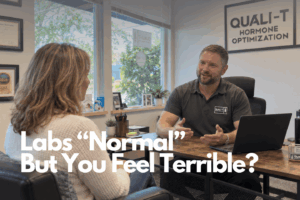
You don’t have to wait until you feel terrible to start asking questions.
FAQs About Perimenopause Age & Hormone Health
What age does perimenopause usually start?
Perimenopause most commonly begins in a woman’s 40s, although some women begin experiencing symptoms in their 30s. The timing and symptoms can vary significantly from one person to another.
Can perimenopause begin at 35?
Yes, it can begin in the 30s for some women. However, symptoms such as fatigue, sleep problems, mood changes and irregular periods can have other causes too, so a medical evaluation can help determine what may be happening.
What are some of the first signs of perimenopause?
Changes in menstrual cycles are common, along with symptoms such as hot flashes, night sweats, sleep problems, mood changes, brain fog, fatigue and changes in sexual health.
Do I have to wait until menopause before discussing hormone therapy?
No. Women can experience significant symptoms during perimenopause, years before menopause occurs. If symptoms are affecting your quality of life, you can discuss possible treatment options with a healthcare provider.
Does being proactive mean starting hormone therapy early?
Not necessarily. Being proactive means paying attention to changes, seeking appropriate evaluation and understanding your options. Hormone therapy may be appropriate for some people but not for everyone.
Can men experience hormonal changes in their 30s and 40s?
Yes. Men can experience changes in testosterone and other aspects of health as they age. Persistent changes in energy, sexual health, strength, body composition or mood are worth discussing with a healthcare provider rather than assuming testosterone is automatically the cause.



No comment yet, add your voice below!